BMW Group Innovation and Motorsports Day 2003
Contents: 1. Preface by Dr. Norbert Reithofer, Board Member BMW AG: Individual Mobility, Dynamic Cars, Responsible Use of Resources - an Inevitable Contradiction in Terms? 2. Shaping the Future: Fascination - Innovation - Technology - Motorsport. (Summary) 3. Magnesium - a Material with Great Perspectives. BMW Group Developing the World's First Composite Magnesium/Aluminium Crankcase. 4. CFP - another Material with Great Perspectives 5. Formula 1 Technology Cast in One Mould 6. Lightweight Technology: Achieving the Right Ecological Balance 7. Bringing Together Reality and the Virtual World: Augmented Reality Setting New Horizons 8. Keeping Your Distance the Comfortable Way: ACC Active Cruise Control 9. ACC Stop & Go: Active Cruise Control for the Low Speed Range 10. Talking Cars: Intelligent Cars Exchanging Information by Themselves 11. Efficient Dynamics: Up to 1,000 Nm Torque on 15% Less Fuel 12. Miniature Head-Up Display: Innovations in Formula 1 and Sailing 13. BMW Motorsport: A Whole Series of Victories - to the Benefit of Series Production 14. A Heritage of Innovation
Preface
Individual Mobility, Dynamic Cars, Responsible Use of Resources -
an Inevitable Contradiction in Terms?
The automotive industry is facing a huge global challenge: to reduce fuel
consumption and minimise CO2 emissions accordingly. And lightweight technology
plays a key role in this context.
The BMW Group is developing new technologies, materials and processes in order
to further improve the efficiency and ecological balance of its cars, whilst
naturally maintaining the highest standard of customer benefits. Following this
underlying objective in our development activities, we are able in the process
to acquire valuable development, production and process-related know-how.
Strategic partnerships are of great significance in this context, allowing us
to use the most advanced and latest technologies. And since there is no such
thing as the 'ideal' all-round lightweight material, the BMW Group, focusing on
process dependability, product quality and economy, is looking for intelligent
combinations of metals and synthetic materials.
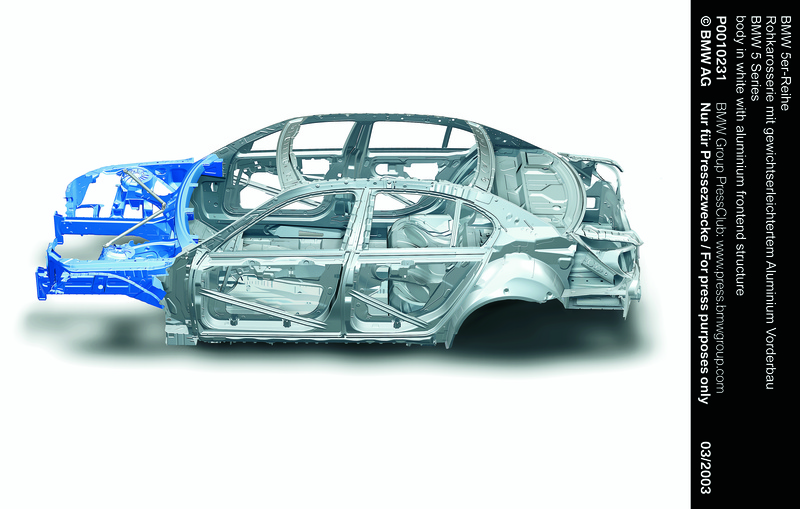
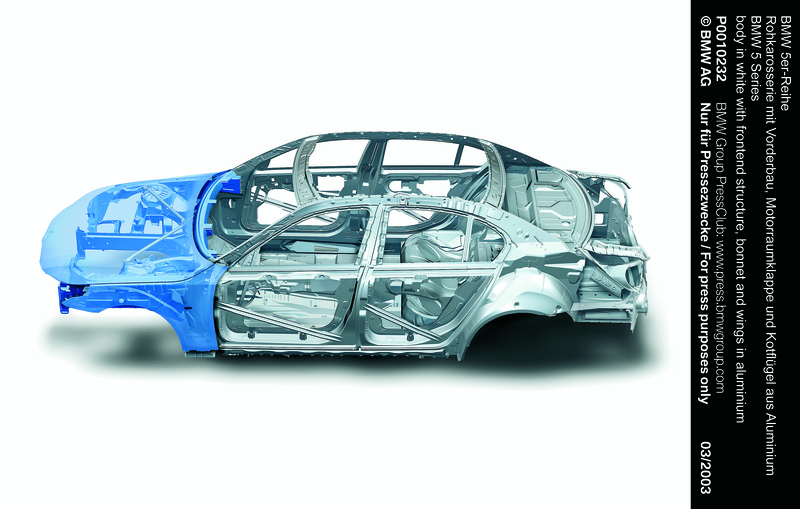
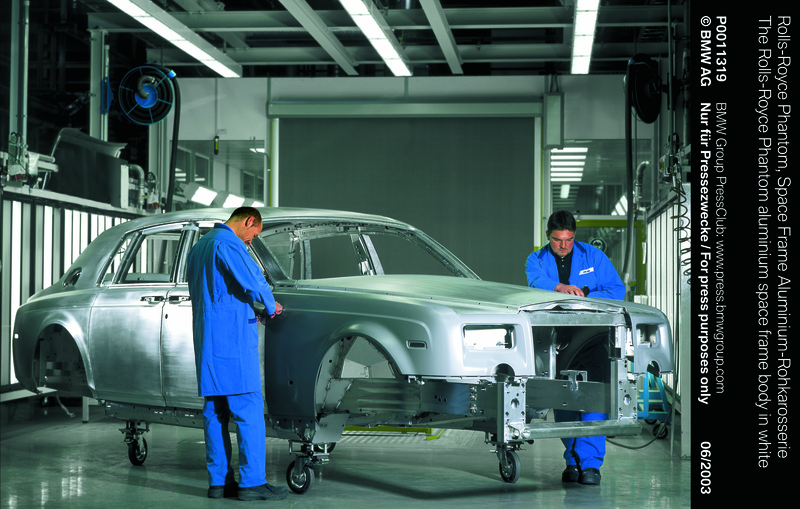
A good example of this development is the new BMW 5 Series Saloon with its
low-weight aluminium front section; another equally good example is the roof of
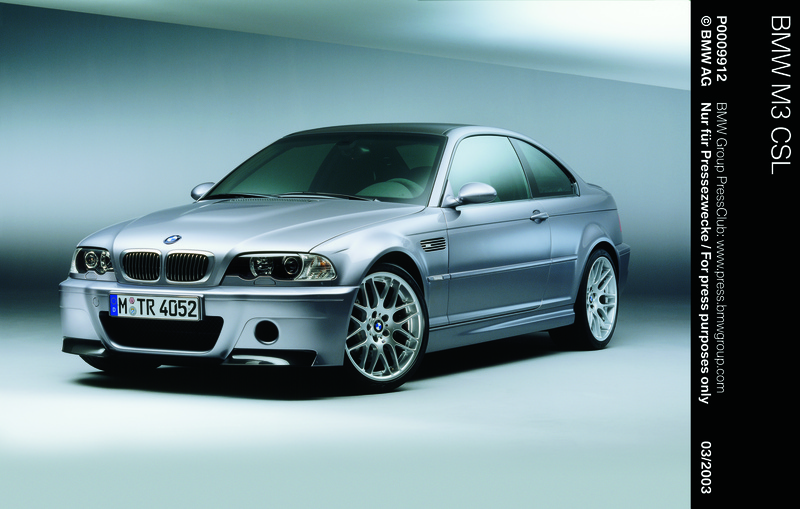
the BMW M3 CSL made of carbon-fibre-reinforced plastic. The result in each case
is greater fuel economy and enhanced driving dynamics. And taking an entirely
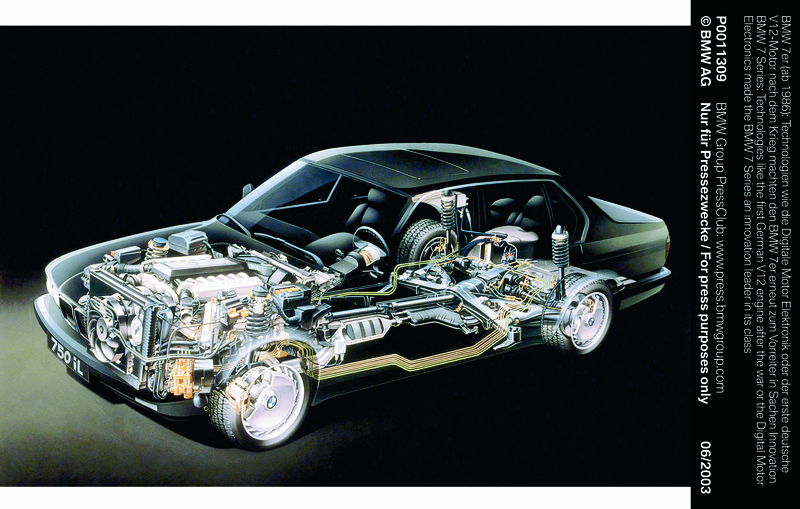
new approach also in engine construction, we are introducing the world's first
composite magnesium / aluminium crankcase.
Preserving the individual's personal mobility is just as important for a
carmaker, especially with traffic volume growing the world over. Seeking to
offer our customers BMW's proverbial sheer driving pleasure also in future, we
realise that we must capitalise on the existing transport routes and network.
Accordingly, we are working on cars incorporating a multitude of different
sensors in order to detect current driving conditions and exchange this
information independently and directly with other vehicles. Detecting traffic
congestion or local hazards efficiently and in good time in this process, these
systems provide extra comfort, greater efficiency, and enhanced safety on the
road.
We also derive valuable synergies for developing new technologies from our
broad-scale involvement in motorsport, with the additional advantage of a
positive, dynamic image not only for the Company and our sporting success but
also for our customers. And last but not least, we are able to look back at a
long tradition of achievements full of success: BMW has always stood for
progress in technology and leadership in innovation. So that now, resting on
this stable foundation, we are able to look into the future full of confidence
and optimism: Through its innovative power, the BMW Group is perfectly prepared
to master the challenges of a successful future also in the long term.
Dr. Norbert Reithofer, Board Member BMW AG.
Chapter 1
2. Shaping the Future. Fascination - Innovation - Technology - Motorsport.
(Summary)
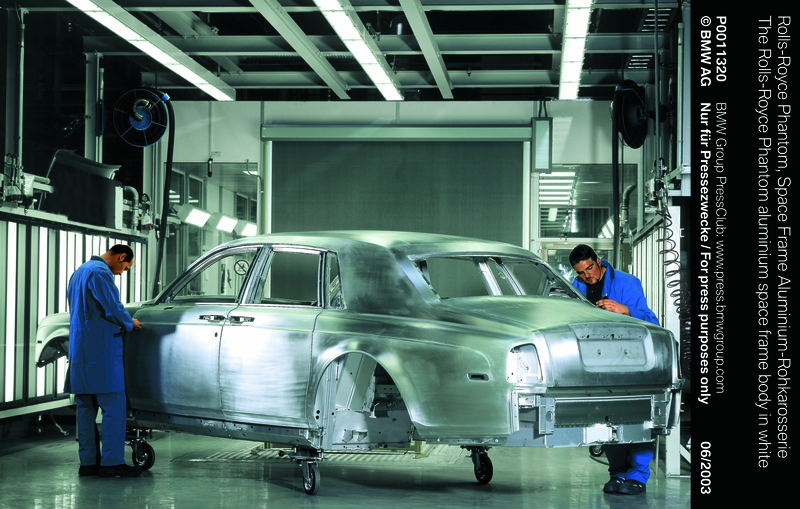
Intelligent lightweight technology is the future:
There is no single, all-round solution for lightweight technology efficient in
structural, design and economic terms and sensible at the same time in
ecological terms. With this in mind BMW Group experts examine and develop the
right concepts and combinations of materials with a clear focus on each vehicle
project. In this process BMW Group specialists are looking in particular at
potentials for saving weight and, accordingly, energy, in conjunction with
advantages in design, structural and functional efficiency. Precisely this
gives the customer direct benefits and advantages, since the driving dynamics
and agility of a car result directly from the right choice of materials. And it
is also here that a stable ecological balance leads to a universal, all-round
focus on materials and, as a result, meaningful material concepts.
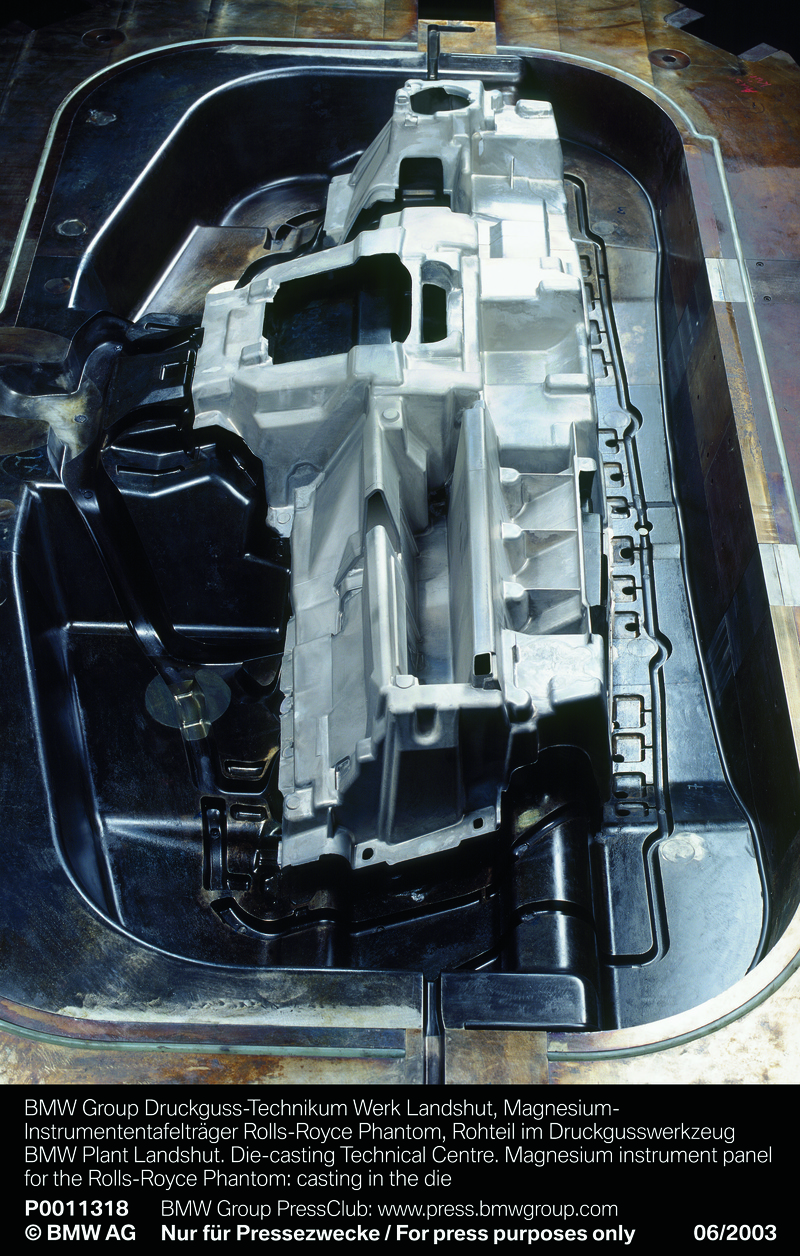
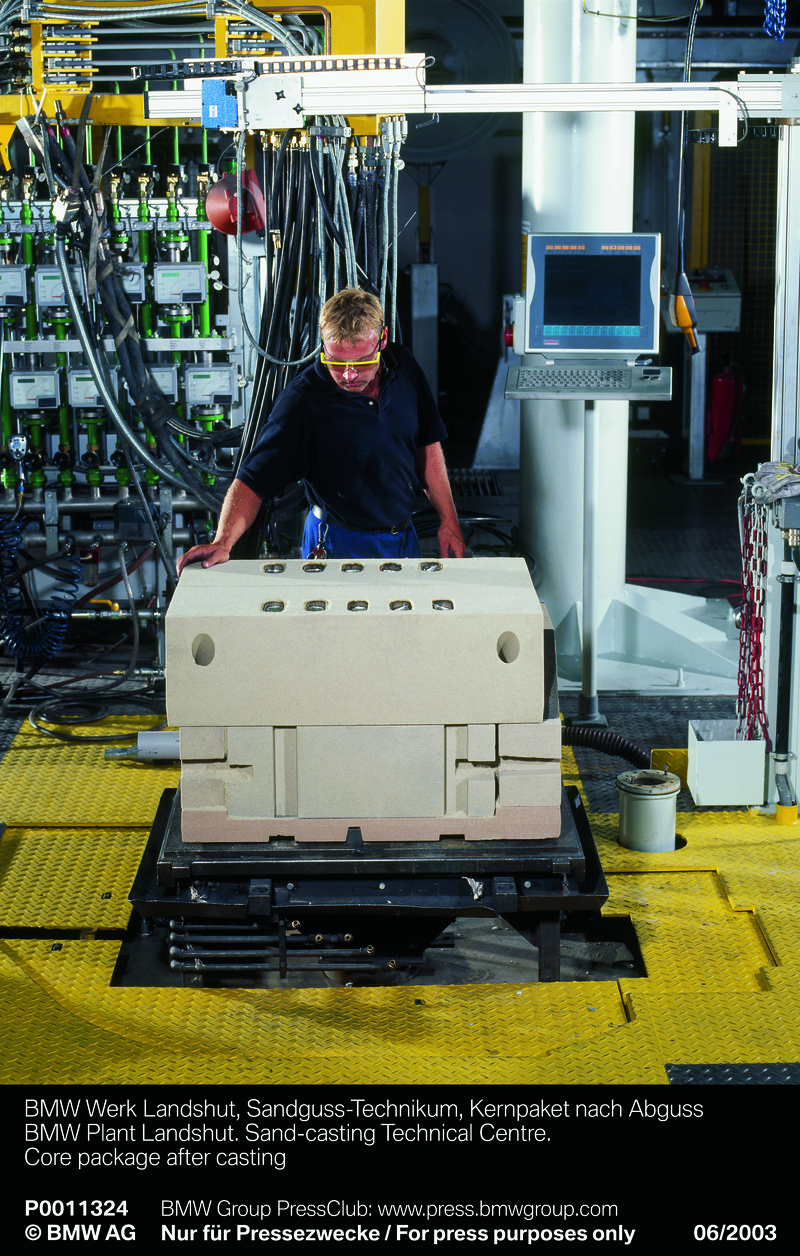
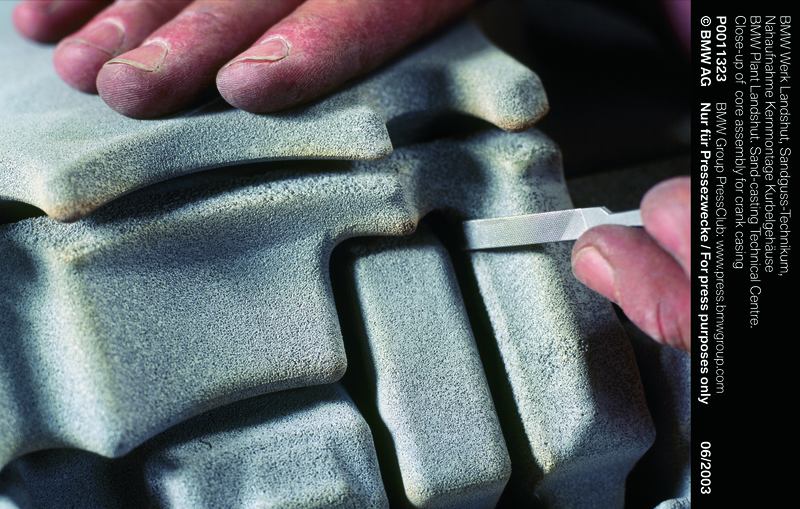
BMW Group clearly defining the use of lightweight magnesium:
Thirty-three per cent lighter than aluminium and 77 per cent lighter than
steel, magnesium offers significant potentials in automotive construction. BMW
Group specialists have therefore developed this material to an even higher
standard, redefining the former limits to the use of aluminium in the
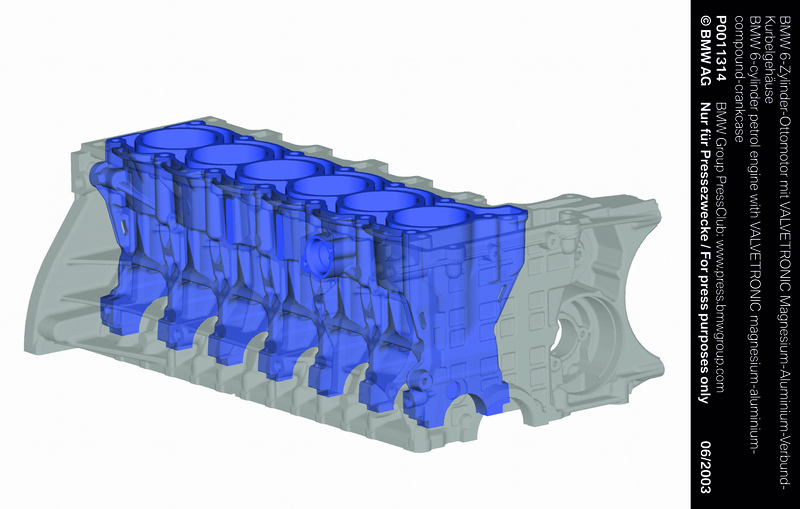
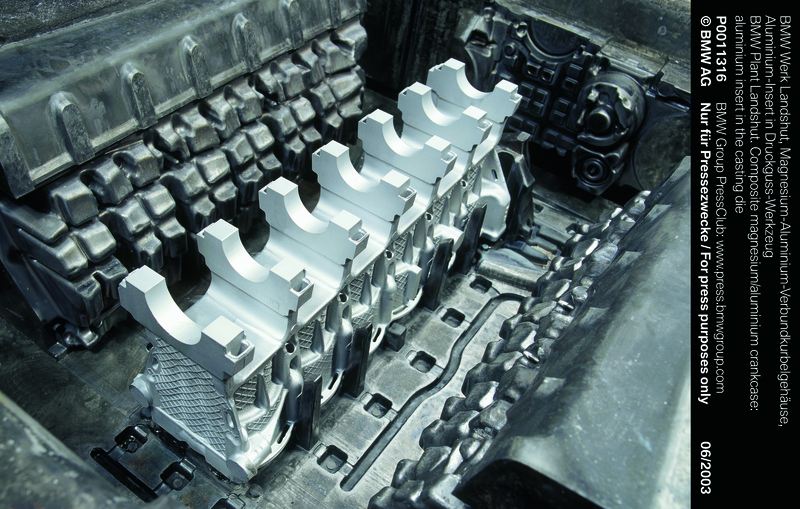
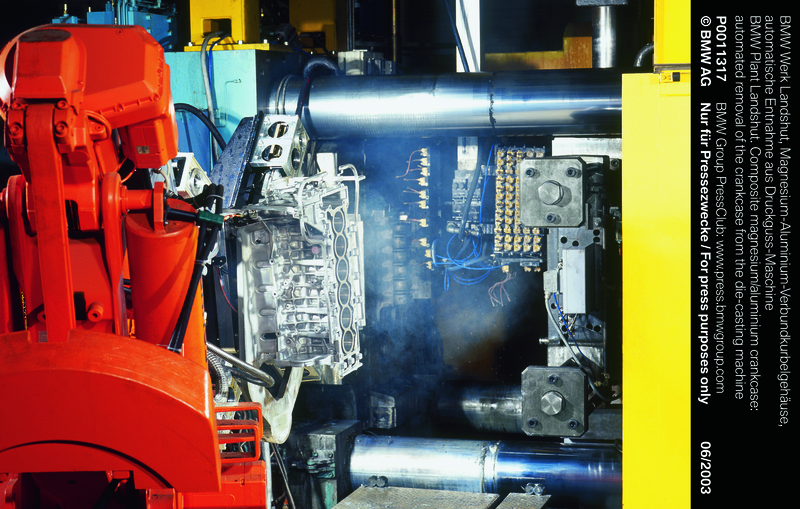
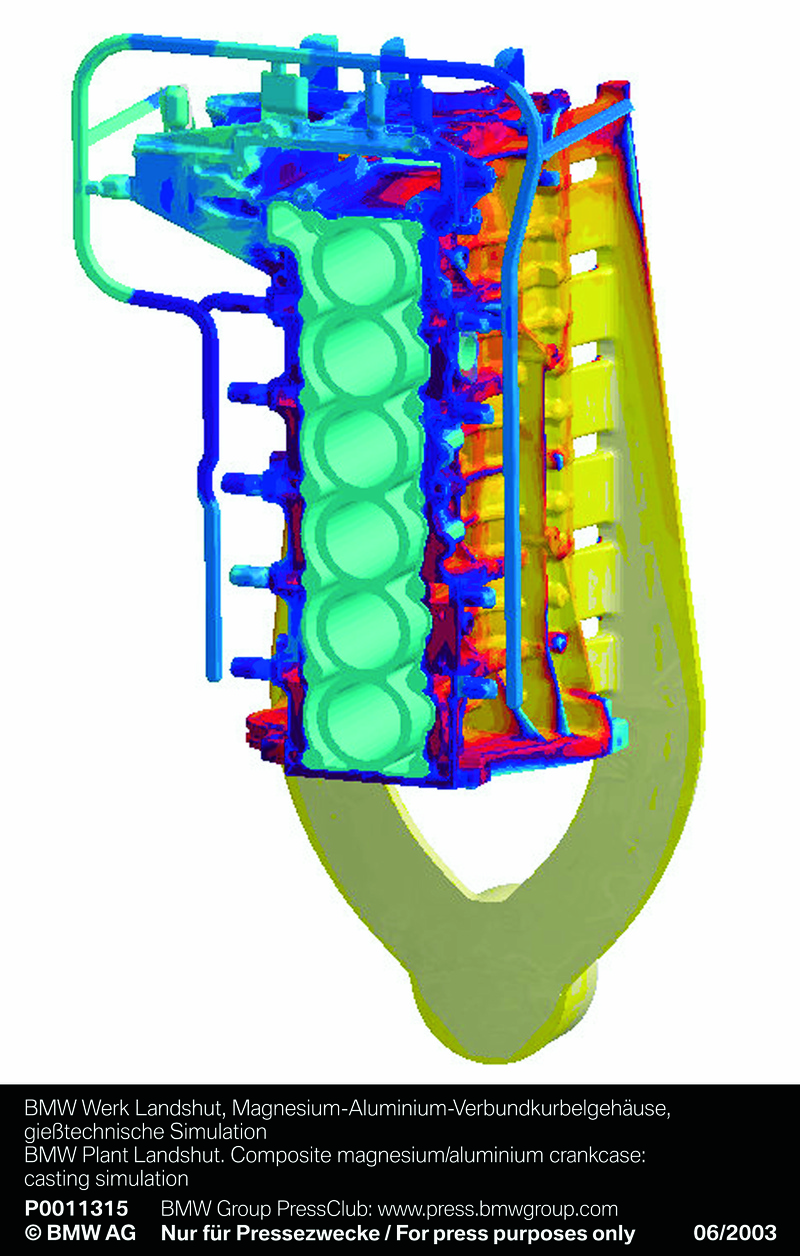
automobile. And introducing the composite crankcase based on a combination of
magnesium and aluminium, the BMW Group is setting a new milestone in materials
and engine technology, the substitution of aluminium by magnesium reducing the
weight of the crankcase by approximately 10 kilos. This development already
close to series production level will be entering regular production in the
next two years.
Intelligent lightweight technology
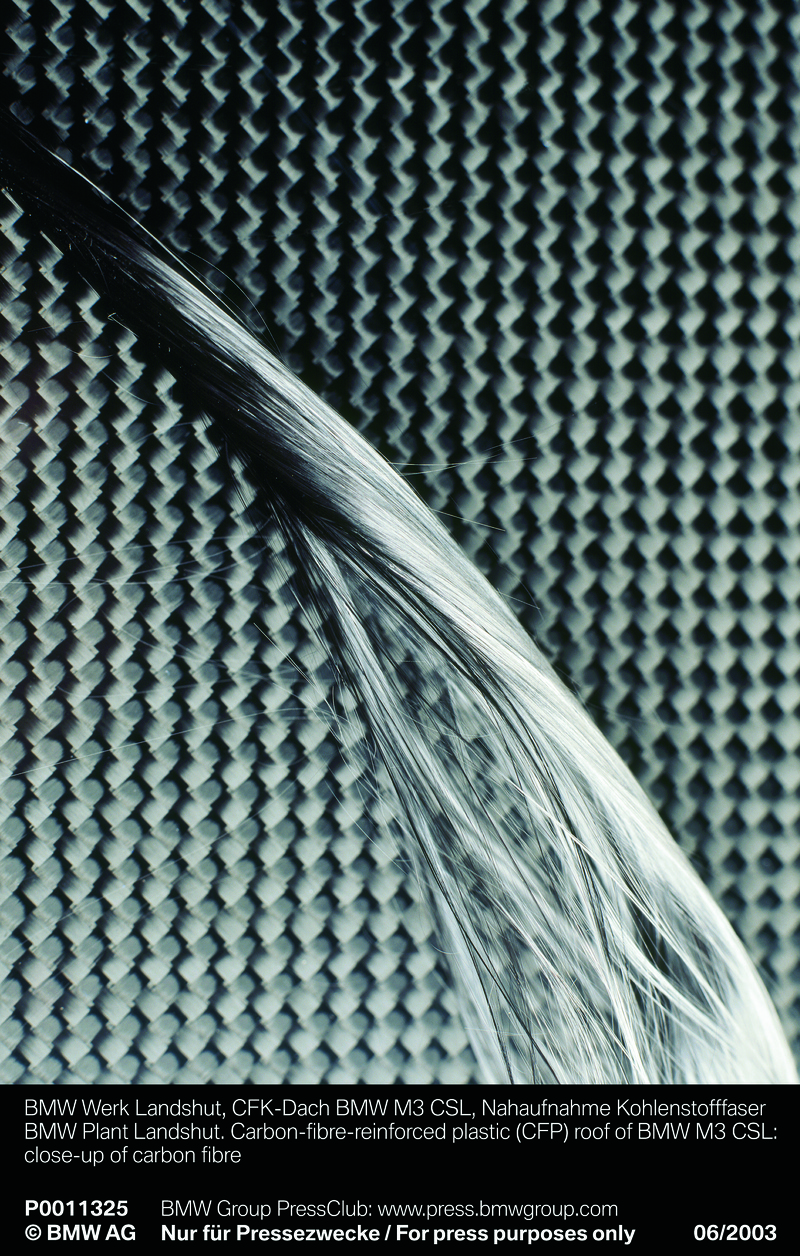
featuring carbon-fibre-reinforced plastics (CFP):
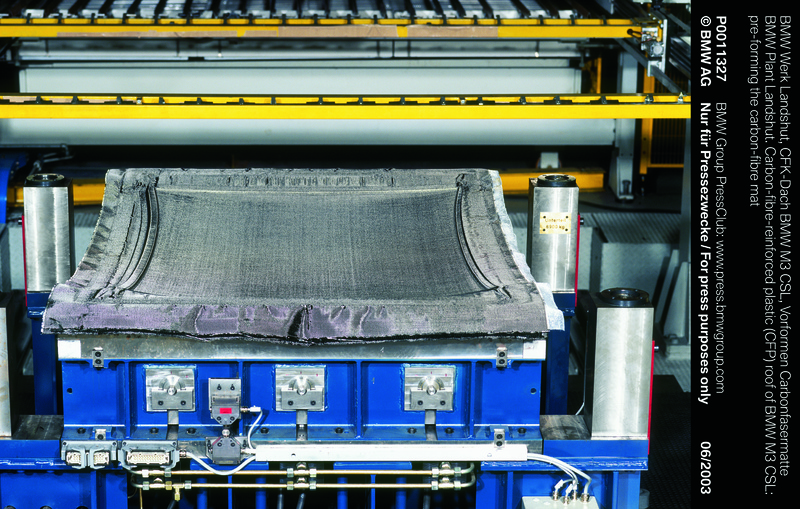
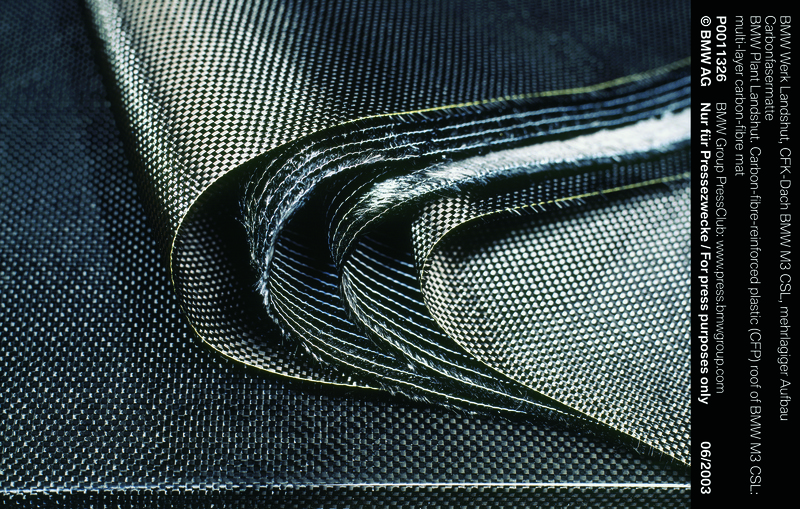
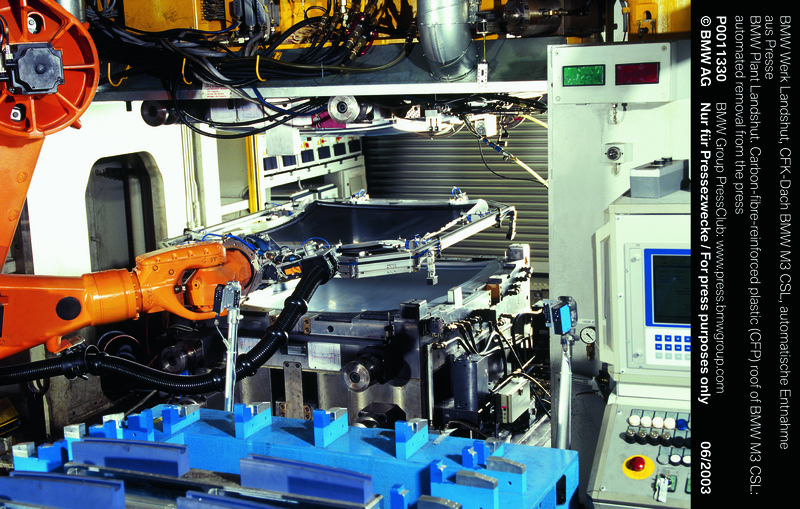
The BMW Group is promoting development and process technologies for the series
use of body structures and components made of carbon-fibre-reinforced plastics
(CFP). An outstanding example of the use of this innovative composite
lightweight material in series production is the CFP roof of the BMW M3 CSL
proudly displaying this material at very first sight. This CFP roof built in
the world's first highly automated production process for CFP body components
at BMW's Landshut Plant offers significant advantages through lower weight
combined with outstanding resistance to both crash forces and corrosion.
So far components made of carbon-fibre and composite carbon materials have
served mainly as individual, one-off parts used in aerospace and motor racing
applications. But wherever there is a need for light, extra-stiff and very
strong materials able to take up substantial loads, designers and construction
engineers are using the advantages of carbon-fibre and composite carbon
constructions to an ever-increasing extent.
Between reality and the virtual world:
Augmented Reality setting new horizons
Focusing consistently on Augmented Reality, BMW is focusing on a technology,
which allows the user wearing data glasses to superimpose virtual,
three-dimensional and animated pictures on to a real background. An area where
this concept might be used efficiently is service, where the mechanic wearing
data glasses is able to superimpose virtual information from the repair manual
on to the 'real' background to obtain all information in real time on complex
processes and keep his hands free for working with maximum efficiency.
ACC Stop & Go Active Cruise Control:
ACC Active Cruise Control complete with a radar distance sensor already helps
the driver of the BMW 5 and 7 Series maintain the right distance from a vehicle
ahead and keep the appropriate speed on the road. And now BMW test cars even
feature an ACC Stop & Go function covering the full range of ACC speed control
all the way to a standstill.
To provide this function, vehicles equipped with ACC use radar sensors to cover
the entire area in front of the car, both further away and close-up. These
sensors determine the distance, the position and speed of vehicles ahead of the
driver's car, ACC Stop & Go then using this information to intervene in the
drive system and apply the brakes in order to keep the right distance from the
vehicle ahead, if necessary, by slowing down the car until it comes to a
complete standstill. Following BMW's underlying philosophy, the driver always
remains in control and is able to intervene whenever necessary. A further point
is that automatic intervention in the brakes is limited, with ACC Stop & Go
requesting the driver in good time to take over whenever necessary.
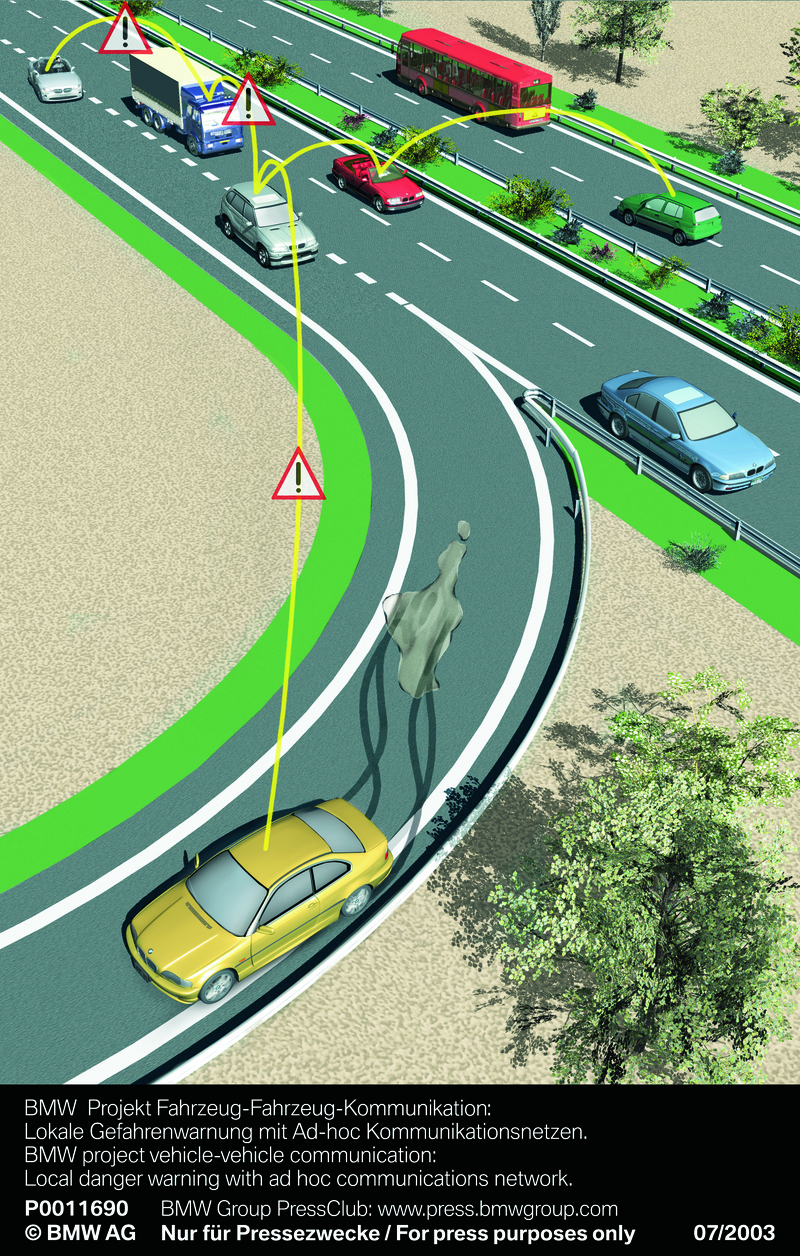
Car/car communication: a direct dialogue without any infrastructure:
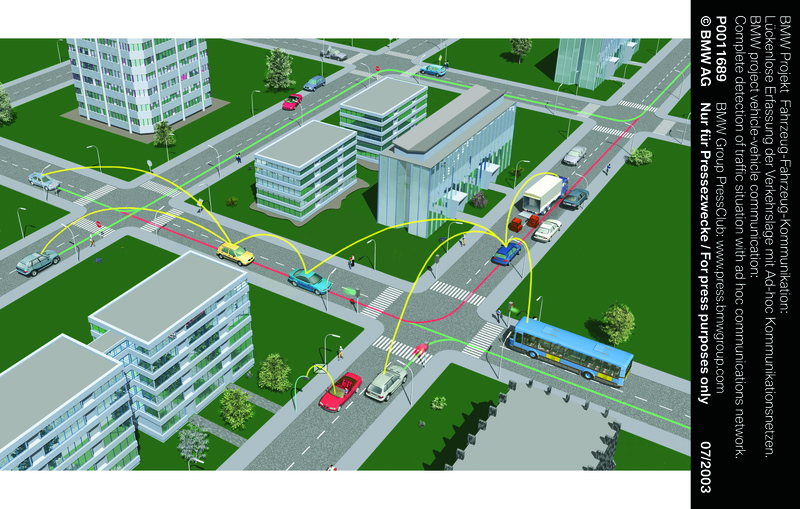
Using ad-hoc communication networks, cars are able to 'talk' directly with one
another, compiling data from their surroundings, processing the information
received and exchanging this input with other cars - quite independently and
without requiring any kind of firm infrastructure. This ensures full coverage
of traffic information as well as possibly hazardous situations monitored
consistently at all times. The big advantage is the optimisation of traffic
flow also on side routes as well as the provision of local hazard warnings
reaching the road user quickly and reliably.
This car/car communication is based on wireless LAN transmission technology
providing the foundation for full coverage ad-hoc networks where the car acts
not only as a sender and receiver, but also as an intermediary in transferring
information.
Efficient dynamics: overcoming an apparent contradiction in terms:
BMW Group engineers have found the right way to overcome a seemingly insoluble
contradiction in terms, thus making the inefficient use of energy in specific
situations a thing of the past.
The objective in this development process is to achieve maximum efficiency in
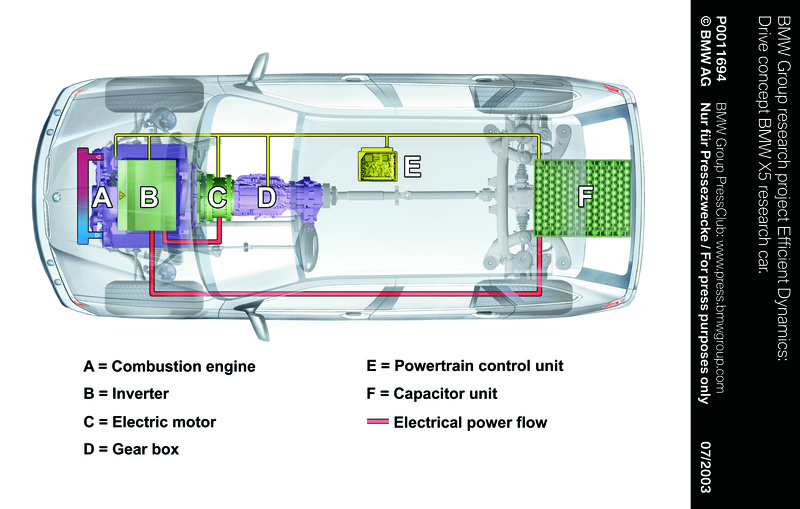
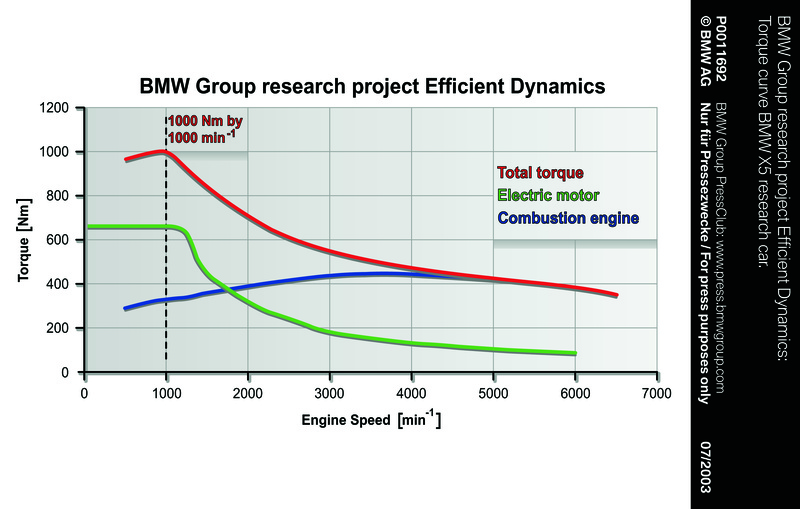
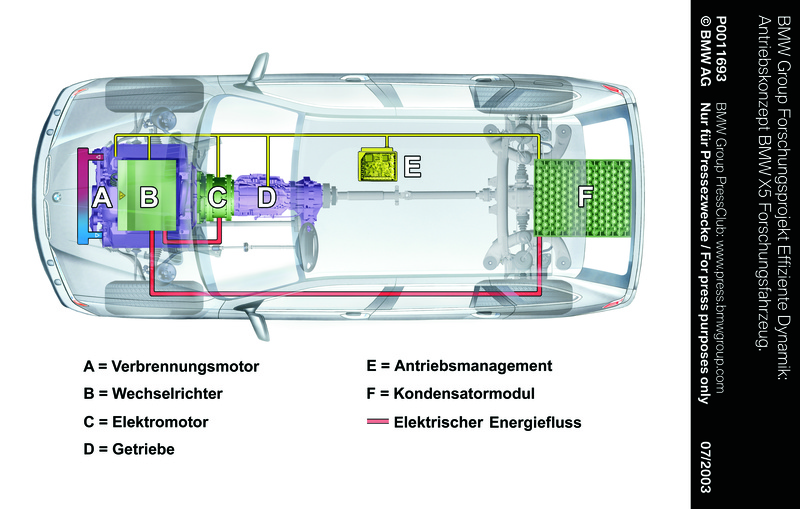
dynamics. And this is made reality in the first BMW X5 research vehicle built
for this purpose, integrating an electric motor between the engine and the
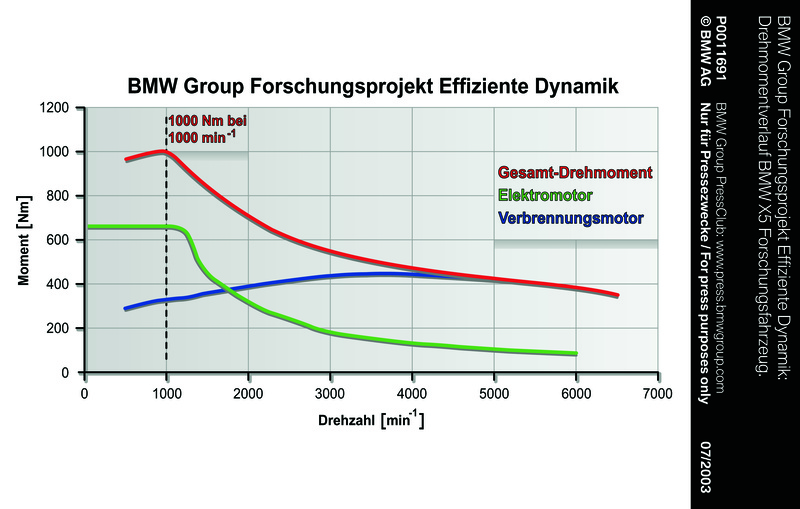
transmission. Boosting the conventional drivetrain when accelerating, this
electric motor is able to increase start-up torque to a peak of up to 1,000 Nm,
the electric motor and combustion engine thus interacting to achieve
unprecedented smoothness and response combined with extra power and performance
particularly at low engine speeds. The electrical energy used in this process
is derived from kinetic energy stored in capacitors whenever the car is driving
in overrun or when the driver applies the brakes. This new technical concept
saves the driver up to 15 per cent fuel by storing brake energy and supporting
and/or reducing loads on the combustion engine under inefficient driving
conditions.
Miniature head-up display:
A new technology from BMW's Technology Office in Palo Alto in Silicon Valley
revolutionises communication processes in sailing: a miniature head-up display
in the sunglasses of the sailors in the ORACLE BMW Racing Team serves to
visually present information directly in the sailor's line of vision. The big
advantage is that the viewer always receives important information right where
he needs it, saving valuable time in taking the necessary action and benefiting
from an enhanced level of safety. Similar technology is used in Ralf
Schumacher's prototype Formula 1 helmet, and at least in technical terms there
are no reasons why this technology should now not be used in everyday motoring.
Transfer of technology from motorsport to series production providing greater
synergies:
Motorsport sets the benchmark for fast work and precise efficiency. Indeed,
this applies particularly to the many engineers and other specialists working
on motorsport applications far away from the race track, focusing untiringly on
even the smallest technical potential allowing the racing driver to compete
with the very best worldwide. Knowledge gained in this process is then used by
engineers in series development, ultimately to the benefit of the customer. And
in exactly the opposite process, professionals in motorsport are able to
capitalise on the wide range of practical knowledge and experience gained in
series production.
BMW motorsport: winning races to the benefit of series production:
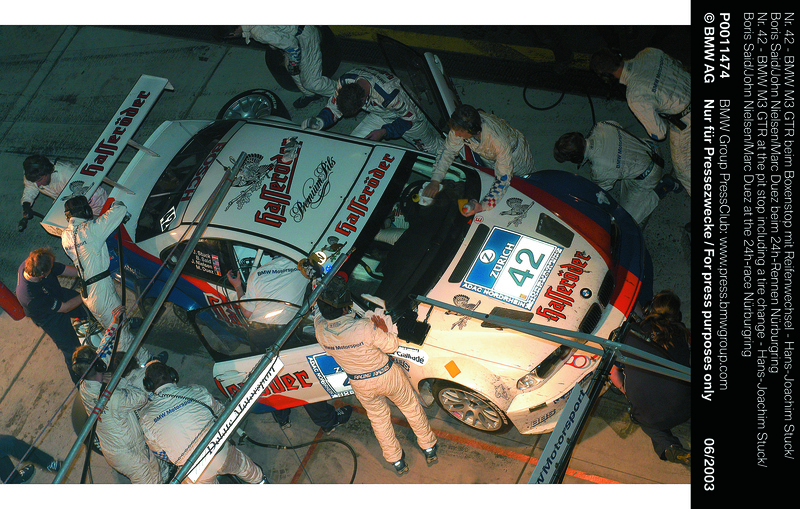
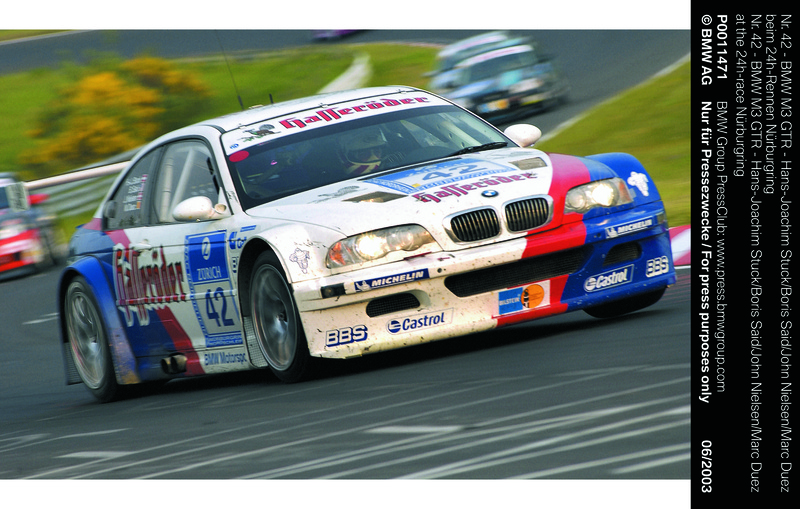
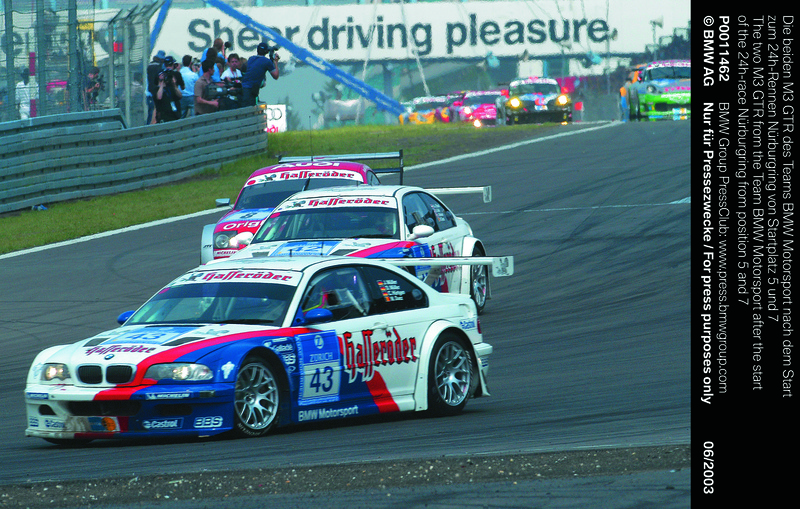
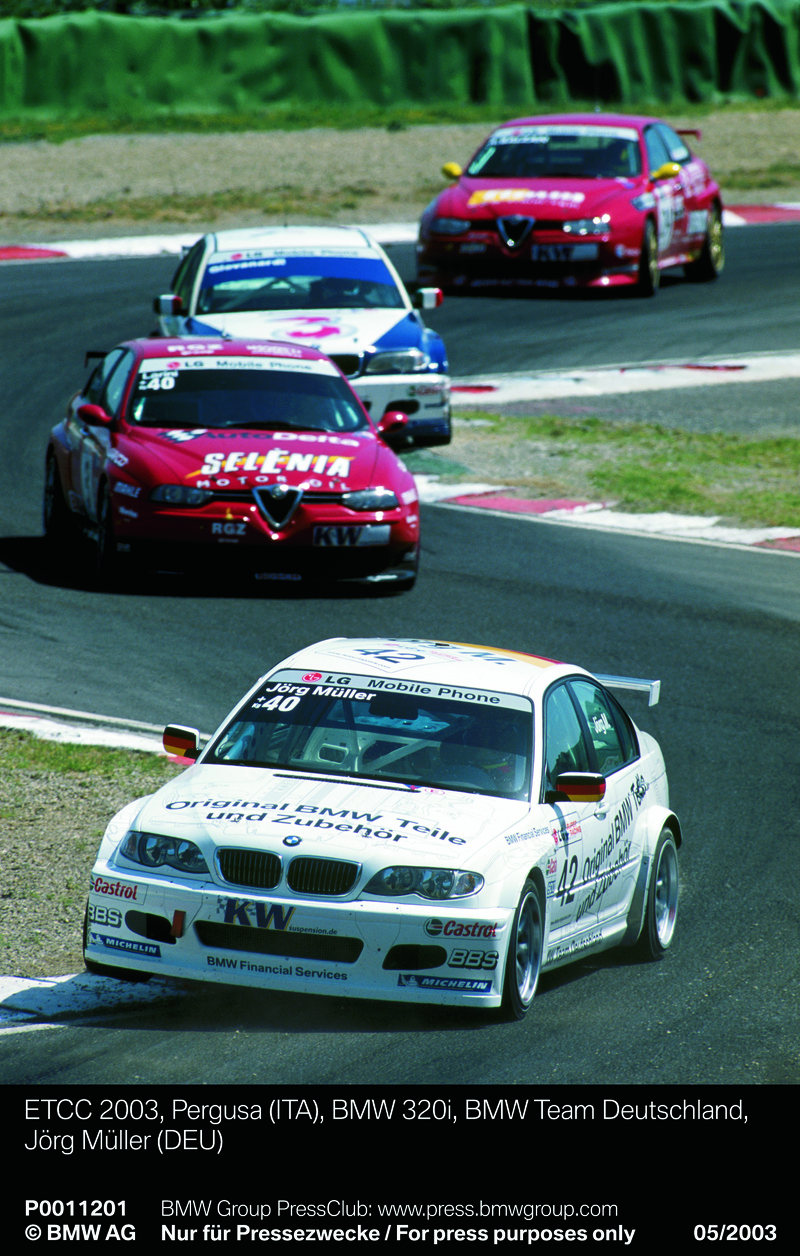
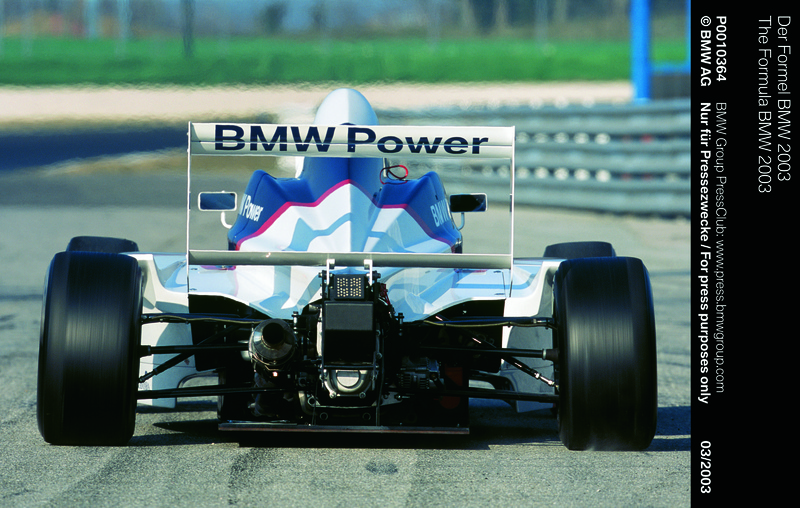
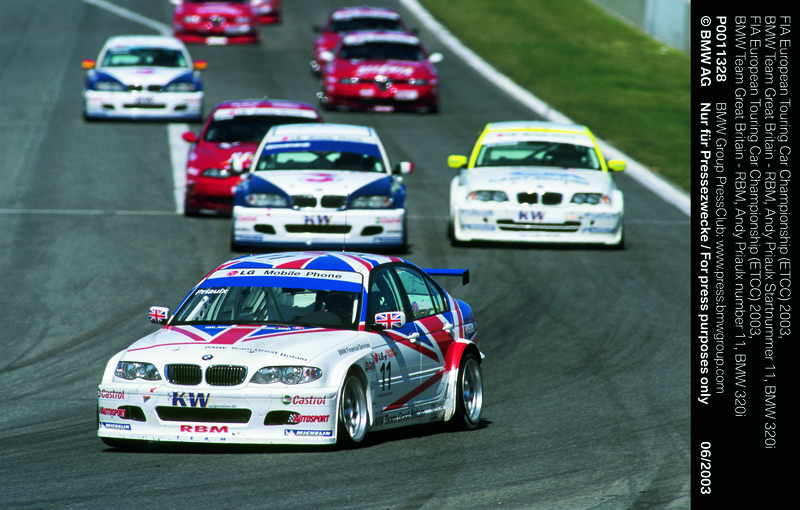
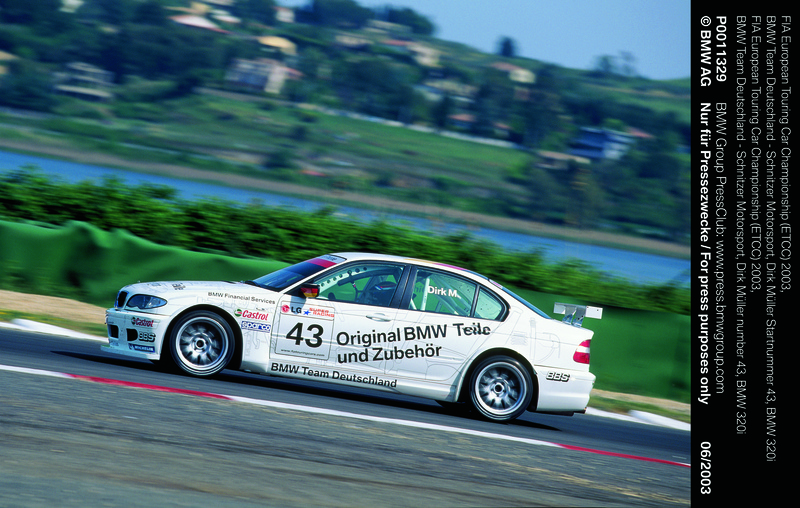
To ensure success in all disciplines of BMW motorsport in 2003 - Formula 1, the
European Touring Car Championship, the 24 Hours of Nürburgring, and the
promotion of talents in Formula BMW - BMW engineers in series production and
motorsport cooperate closely as one team. Indeed, BMW motorsport serves as a
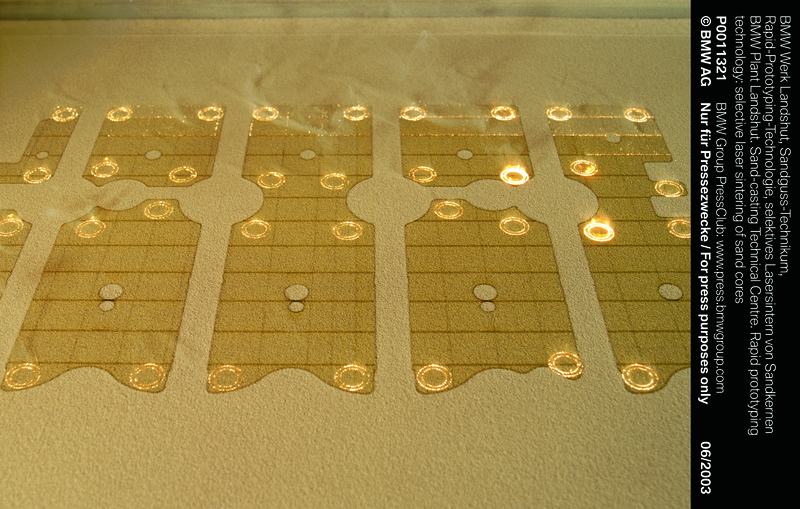
kind of high-tech lab in research and development, construction, rapid
prototyping, electronics, production, and in other areas. Pressure for
performance straight from the race track serves to speed up and optimise
developments in Munich, and the know-how of BMW's series production engineers
forms a strong and stable foundation.
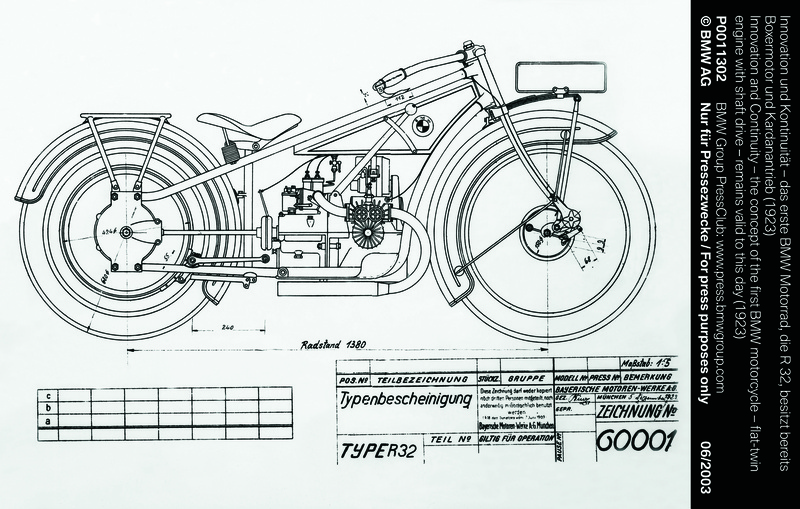
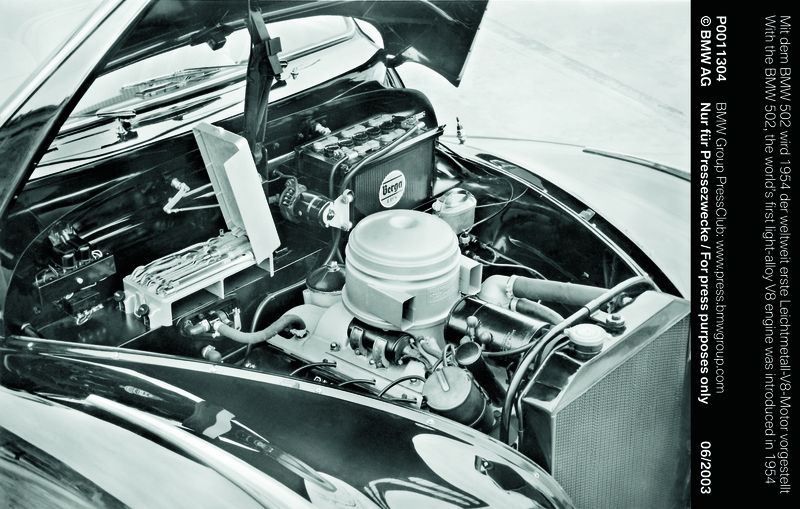
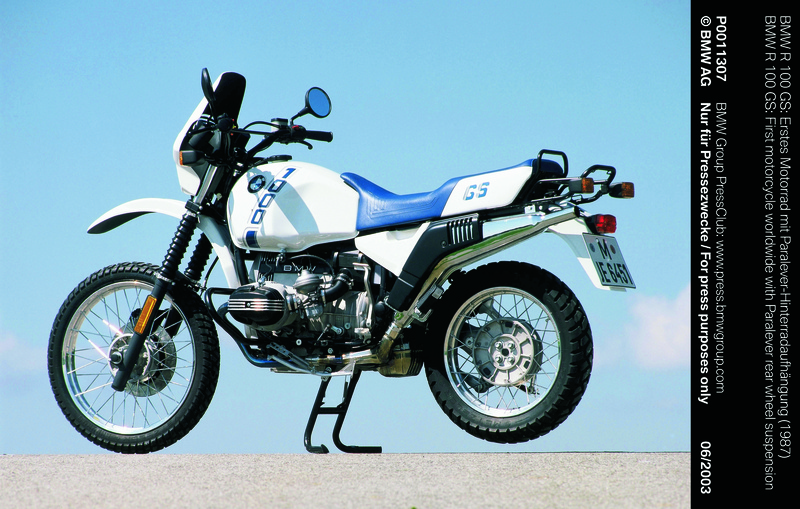
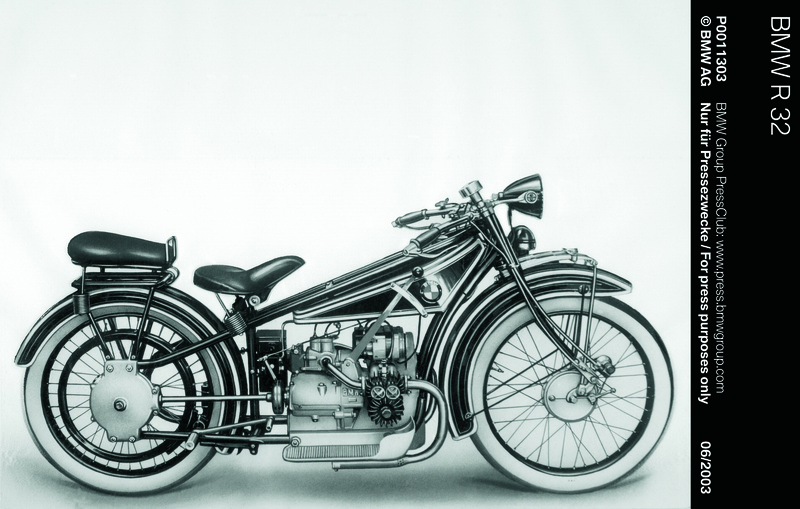
The BMW Group: a great heritage of innovation:
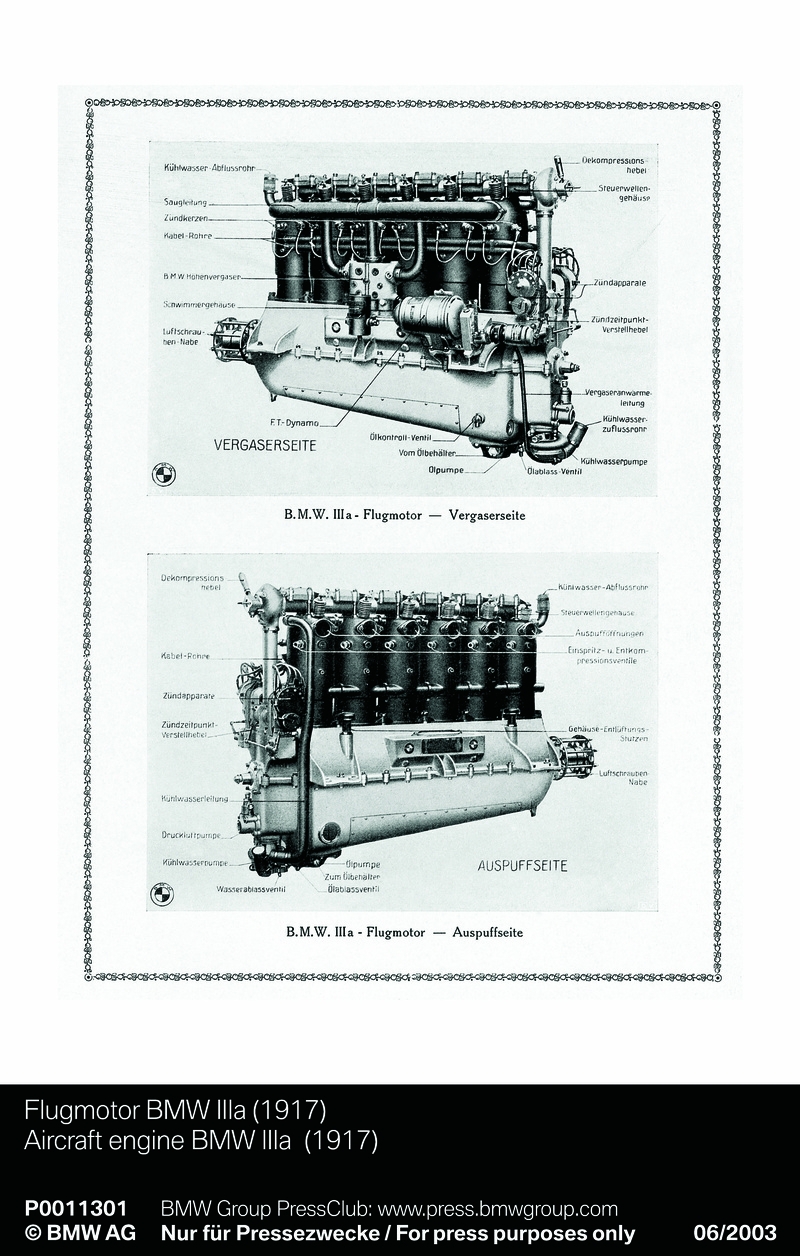
The BMW Group has always seen innovation as a guarantee for success on the road
and in business. In many areas, particularly in engine technology and
electronics, BMW was and still is the pacemaker for new technologies. And the
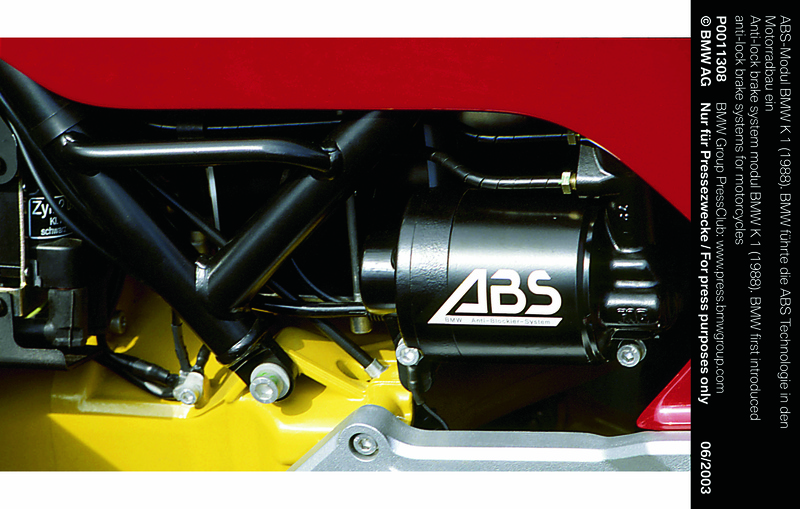
list of achievements is truly impressive, ranging from the first electronic
speedometer with a fuel consumption indicator and Check/Control through the
world's first electrohydraulic anti-lock brake system (ABS) all the way to the
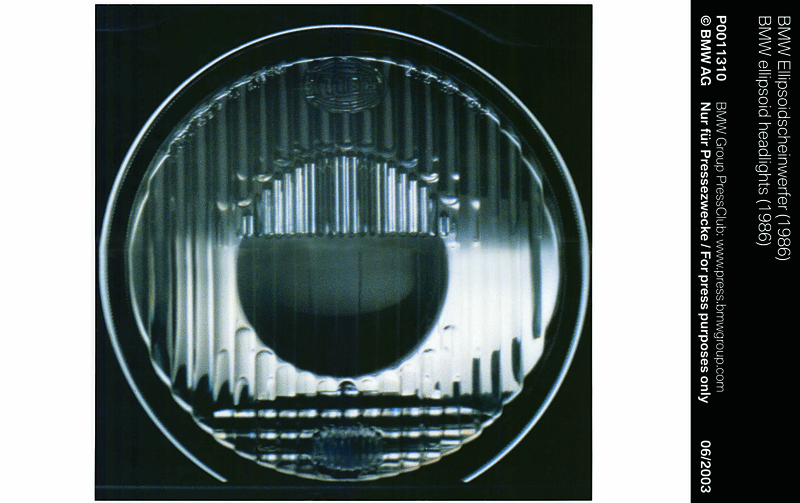
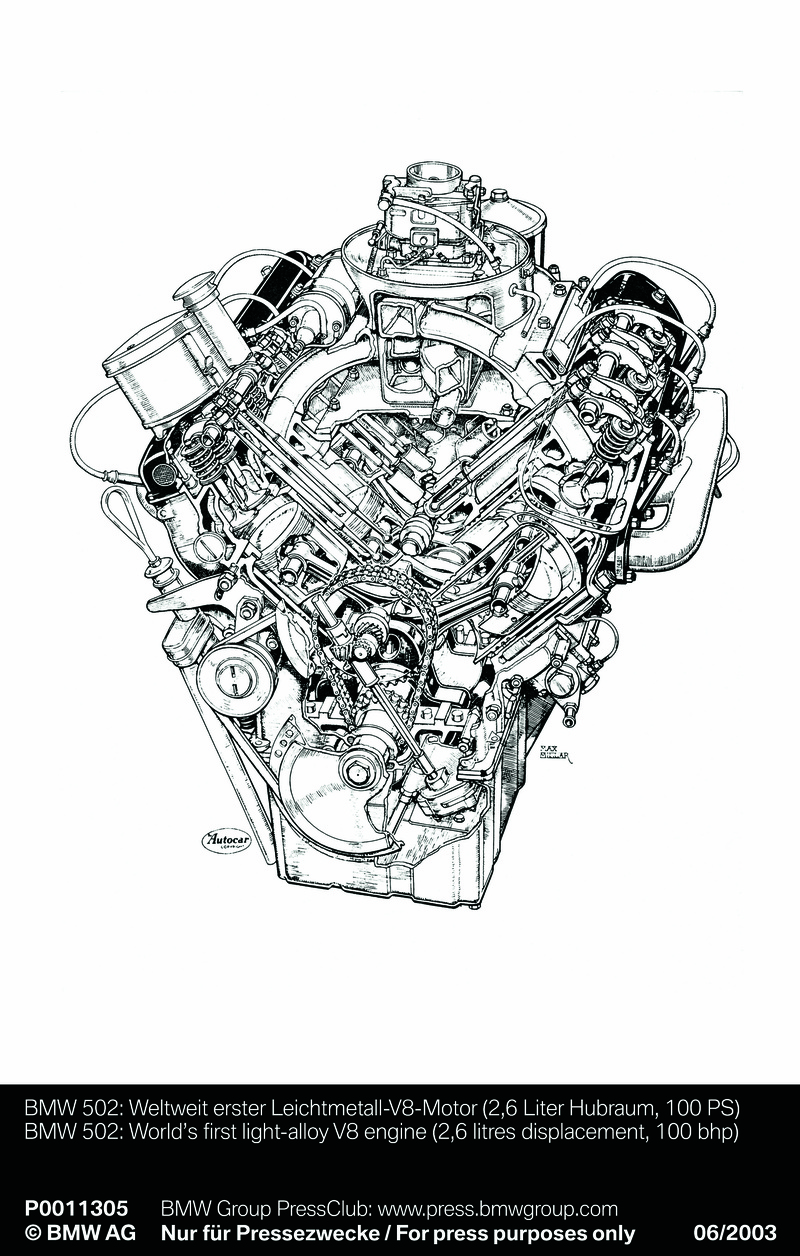
introduction of xenon headlights and the ITS head airbag in the 7 Series. A
particularly outstanding example of such developments in engine technology, in
turn, is the BMW Group's fully variable VALVETRONIC valve control.
Proceeding from this experience, the BMW Group will continue to actively shape
the future, already paving the way for environmentally compatible mobility back
in 1994 with the world's first series production of dual-mode natural gas cars.
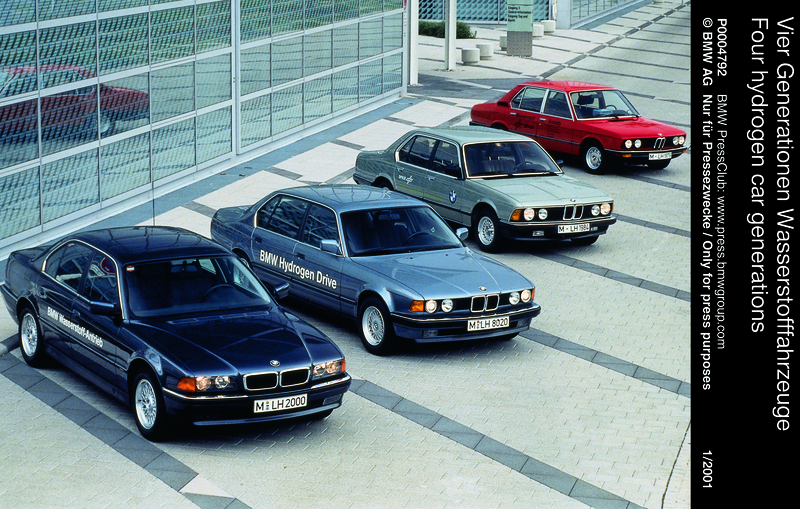
Then, on the occasion of the Expo 2000 World Fair, the BMW Group presented the
first fleet of 15 BMW 750hL research cars featuring a hydrogen-powered
combustion engine. In the meantime BMW is already working all-out on the first
series production car in the world with hydrogen drive.